
Father’s Day in the United States is a 60-year-old national tradition rooted in the efforts of a daughter in Spokane, Washington. Today, the 3rd Sunday in June serves as a day for backyard barbecues, baseball games, and roughly $24 billion in consumer spending.
The Origin Story
Sonora Smart Dodd founded Father’s Day in 1910. Her father, William Jackson Smart, was a Civil War veteran who raised 6 children on his own after his wife died in childbirth. Sonora felt her father deserved the same recognition that mothers received.
The first celebration took place on June 19, 1910, at the YMCA in Spokane. Sonora originally proposed her father’s birthday, June 5, but the local ministers needed more time to prepare their sermons. They settled on the 3rd Sunday of the month.
The Long Road to Federal Recognition
Mother’s Day became an official holiday in 1914, but Father’s Day faced a much harder path. Many men in the early 20th century viewed the holiday as unmasculine. They saw it as an attempt by retailers to replicate the commercial success of Mother’s Day by selling more ties, hats, and tobacco.
Legislative milestones:
- 1916: President Woodrow Wilson traveled to Spokane to speak at a Father’s Day celebration. He attempted to make it official, but Congress resisted, fearing commercialization.
- 1924: President Calvin Coolidge recommended that the holiday be observed nationwide to “establish more intimate relations between fathers and their children.”
- 1966: President Lyndon B. Johnson issued the first presidential proclamation designating the 3rd Sunday in June as Father’s Day.
- 1972: President Richard Nixon signed the law that made Father’s Day a permanent national holiday.
Modern Traditions and Celebrations
Americans celebrate Father’s Day through specific activities that prioritize leisure and family time.
The Backyard Barbecue
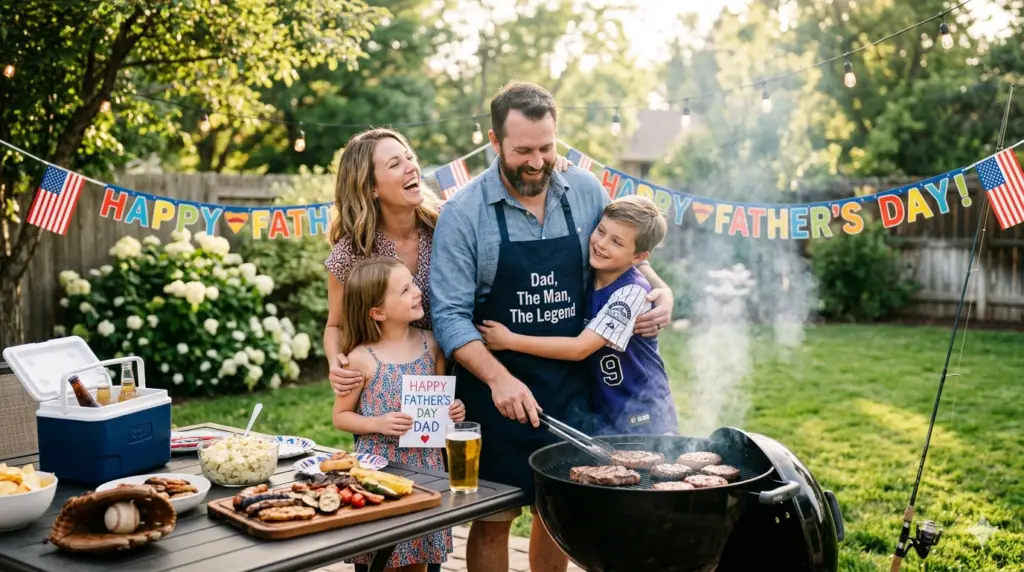
The grill is the center of the holiday for many. Families gather for cookouts featuring steaks, ribs, and burgers. This tradition aligns with the June weather across most of the country. Retailers report a spike in charcoal, propane, and grilling tool sales in the 2 weeks leading up to the date.
Outdoor Recreation
Fishing is one of the most common activities. Many states offer “Free Fishing Days” during Father’s Day weekend, allowing people to fish without a license. Other popular activities include:
- Golf: Father’s Day Sunday is usually the final round of the U.S. Open, one of the most prestigious tournaments in professional golf.
- Hiking and Camping: National parks see high attendance during this weekend as families take advantage of the early summer season.
Sports and Community
Baseball is deeply linked to the holiday. Major League Baseball (MLB) players often wear blue ribbons and use blue bats to raise awareness for prostate cancer. Attending a stadium game or playing catch in a local park are standard ways to spend the afternoon.
Gift Giving Trends
Americans spend an average of $200 per person on Father’s Day gifts. While the “necktie” is a cliché, it remains a consistent seller. However, spending has shifted toward experiences and high-tech items.
Common Gift Categories:
- Electronics: Smartwatches, noise-canceling headphones, and tablets.
- Tools and Home Improvement: Cordless drills, specialized wrenches, and smart home devices.
- Personal Care: High-end razors, beard oils, and colognes.
- Subscription Services: Streaming platforms, meal kits, or monthly coffee deliveries.
Economic Impact
The National Retail Federation (NRF) tracks spending annually. In 2026, spending expectations remain high.
- Greeting Cards: 72 million Father’s Day cards are exchanged annually. It is the 4th largest card-sending holiday in the U.S.
- Dining Out: Roughly 40% of consumers plan to take their father to a restaurant, making it one of the busiest days of the year for the food service industry.
- Clothing: Apparel remains the most popular gift category, purchased by 55% of shoppers.
Regional Variations
While the core themes remain the same, different parts of the U.S. add local flavor to the day.
- South: Celebrations often include heavy focus on slow-smoked brisket or pulled pork, following regional barbecue styles.
- Pacific Northwest: Reflecting the holiday’s roots in Washington, outdoor activities like kayaking or coastal trips are prevalent.
- Northeast: City-dwellers often opt for brunch or attending professional baseball games in historic parks like Fenway or Yankee Stadium.
The Role of Stepfathers and Mentors
In the last 20 years, the scope of the holiday has widened. Many Americans use the day to honor stepfathers, grandfathers, uncles, and mentors. This shift is reflected in the greeting card industry, which now produces a significant percentage of cards addressed to non-biological father figures.
Global Comparison
While Sonora Smart Dodd’s version influenced the world, other countries celebrate on different dates and with different customs.
- Germany: Celebrated on Ascension Day. Men often hike into the woods pulling wagons filled with beer and regional food.
- Thailand: Celebrated on December 5, the birthday of the late King Bhumibol Adulyadej. It is traditional to wear yellow and give Canna flowers to fathers.
- Mexico: Like the U.S., Mexico celebrates on the 3rd Sunday of June. The “Carrera del Día del Padre” (Father’s Day Race) in Mexico City is a major annual event.
Changing Perspectives on Fatherhood
The way Americans celebrate Father’s Day reflects changing social roles. Early 20th-century celebrations focused on the father as the “provider” and “disciplinarian.” Modern celebrations emphasize the father’s role in active parenting and emotional support.
Dads today spend nearly triple the amount of time on childcare than they did in 1965. This change has shifted the holiday focus from “giving dad a break” from a distant role to “spending quality time” together.
Planning a 2026 Celebration
Father’s Day falls on June 21, 2026. If you are organizing an event, specific details matter more than grand gestures.
1. Determine the Pace
Ask if the goal is relaxation or activity. Some fathers prefer a quiet morning with a newspaper and coffee, while others want a full day of mountain biking or household projects.
2. Focus on Food
Avoid complicated menus that keep the host in the kitchen and away from the family. One-pot meals, taco bars, or outdoor grilling allows for better conversation.
3. Choose Practical Gifts
The most successful gifts solve a specific problem. A headlamp for a father who likes evening runs is more useful than a decorative desk ornament.
4. Opt for Experiences
Recent data shows that 30% of shoppers now prefer “gifts of experience.” Consider tickets to a concert, a brewery tour, or a guided fishing trip.
Fast Facts for 2026
- Date: Sunday, June 21, 2026.
- Origin: Spokane, Washington (1910).
- Official Status: Signed into law by Richard Nixon in 1972.
- Average Spend: Expected to exceed $199 per person.
Summary of American Traditions
Most families follow a familiar pattern: a card in the morning, an outdoor activity in the afternoon, and a shared meal in the evening. While the gadgets and prices change, the core intent—recognizing paternal influence—remains the same as it was in 1910.